

Table of Contents
- Why Eco Friendly Children Travel Products Are Worth the Investment
- What to Look For in Sustainable Kids Travel Gear
- Eco-Friendly Kids Luggage and Carry Solutions
- Building a Kids Travel Activity Kit That Lasts
- Sustainable Children's Camping Gear for Family Trips
- Common Mistakes When Buying Eco Friendly Children Travel Products
- Conclusion
- Frequently Asked Questions
Last Updated: October 11, 2026
Why Eco Friendly Children Travel Products Are Worth the Investment
Eco friendly children travel products are gear items made from sustainable or recycled materials that are designed to be durable enough for repeated trips, rather than replaced every season. For families juggling camping trips, nursery drop-offs and long drives, that durability is the real selling point.
Cheap travel bedding and luggage fail in predictable ways. Zips split, linings tear, and the whole thing ends up in landfill within a year. Better-made gear costs more upfront but survives mud, sand, washing machines and constant packing.
At Cozie Dozie Co., we build our range around recycled French linen and waterproof canvas backing, because those materials handle exactly that kind of punishment. Below, we break down what actually matters when you're choosing sustainable travel gear for kids, and where most buyers waste their money.

The short version: buy for washability and material honesty first, then worry about the rest.
What to Look For in Sustainable Kids Travel Gear
The best sustainable kids travel gear balances three things: a material that survives real use, a claim you can verify, and a size that actually fits your car. Skip any one of those and you'll regret the purchase.
Materials That Hold Up to Real Use
Linen and cotton canvas beat most synthetics for breathability and comfort, and they age well rather than degrading. Recycled linen performs the same as new linen because the fibre structure doesn't change during recycling.
Watch for these material signals:
- Certified recycled content rather than vague "eco" wording
- Waterproof backing if the item will touch wet ground or grass
- Machine-washable construction, because kids' gear gets filthy
- Reinforced seams at stress points like handles and zip ends
A common mistake is buying a beautiful natural-fibre item with no waterproof layer. One wet camping morning and it's unusable.
Certifications and Ethical Claims Worth Checking
Vague sustainability language is everywhere, and "eco-friendly" on a label means very little on its own. Look for named certifications and a stated country or factory of manufacture. If a brand won't tell you where something is made, that's your answer.
Australia's consumer regulator, the ACCC guidance on environmental and sustainability claims, has been cracking down on greenwashing, so reputable sellers now publish specifics. Ask directly: what is it made from, where is it made, and can you show me?
Eco-Friendly Kids Luggage and Carry Solutions
Eco-friendly kids luggage works best when it's light enough for a child to carry and tough enough to survive being dragged. That combination rules out most novelty character cases, which are heavy and rarely repairable.
Prioritise these features:
| Feature | Why It Matters | What to Avoid |
|---|---|---|
| Weight | Kids carry their own bag | Hard plastic shells |
| Material | Recycled fabric or canvas | Unspecified "polyester blend" |
| Repairability | Extends usable life | Glued, sealed construction |
| Washability | Handles spills and mud | Spot-clean-only finishes |
Soft-sided bags in recycled canvas or linen blend win for most families. They squash into a packed car, survive being sat on, and can go in the washing machine.
If you want one item that does double duty, a lounger that doubles as a rest spot and a carry-friendly bundle makes more sense than three separate purchases. Our Joey + Drink Bottle Bundle is built exactly for that: a flat-packed lounger plus a vacuum-sealed stainless-steel bottle, so there's one thing to pack instead of two.

Building a Kids Travel Activity Kit That Lasts
A kids travel activity kit should be built from reusable, repairable items, not a bag of plastic toys that break before you reach your destination. The goal is a small kit that gets used on every trip for years.
Build yours around these categories:
- Reusable drawing tools: a small chalkboard, or a sturdy notebook and pencils
- Open-ended play: wooden blocks, felt story pieces, or magnetic tiles
- Comfort item: a familiar blanket or small cushion for unfamiliar spaces
- Snacks and hydration: a durable drink bottle rather than single-use cartons
That last point matters more than people expect. A good stainless-steel bottle replaces hundreds of disposable ones over a childhood. Our Cozie Dozie Drink Bottle is vacuum-sealed, keeps water cold through hot afternoons, and has a leak-proof straw lid sized for little hands.
Sustainable Children's Camping Gear for Family Trips
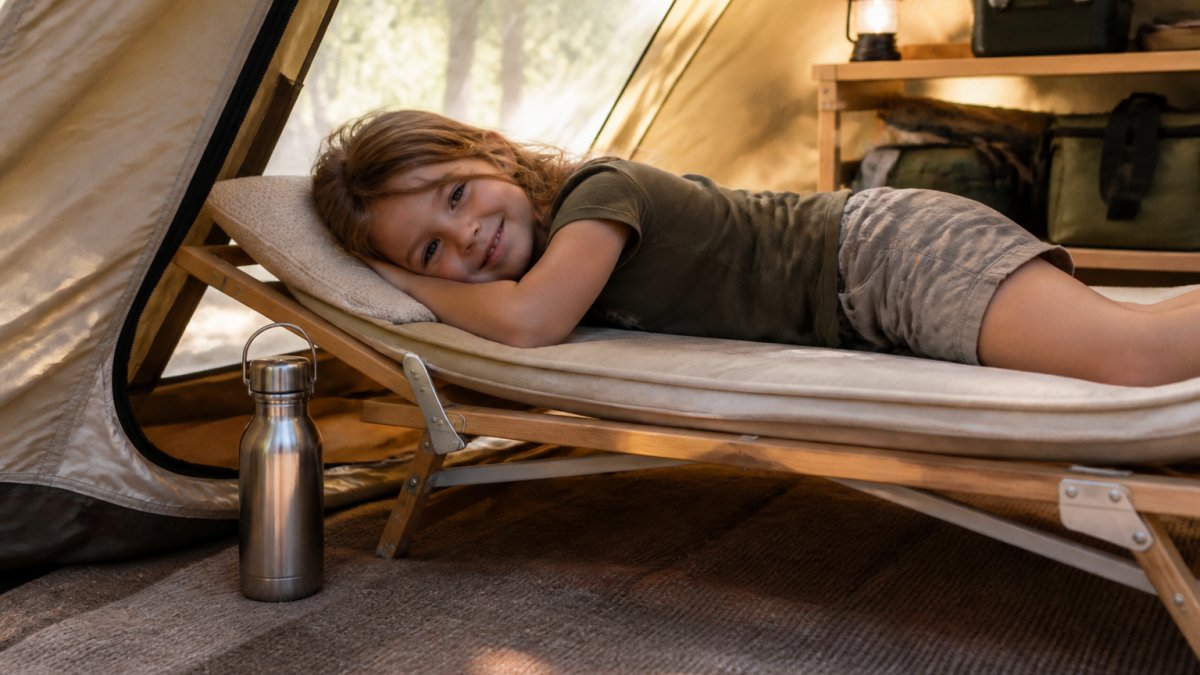
Sustainable children's camping gear needs to handle temperature swings, damp ground and rough handling, all while packing down small. Natural-fibre bedding with a waterproof base outperforms thin synthetic mats for comfort, and it lasts longer.
Sleep and Rest Setups That Travel Well
The single biggest factor in whether a child settles away from home is familiarity. Same bedding, same shape, same feel, and the brain stops treating the new place as a threat.
That's the thinking behind our sensory floor beds and kids' swags. They're flat-packed, so they fill with standard pillows or foam at home, and the butter-soft recycled French linen top sheet feels the same on night one as it does on night fifty. Families with sensory-sensitive kids tell us the consistency is what makes the difference, not the novelty.
For families heading off-grid, the official guidance on safe camping and bushfire awareness is worth reading before you pack, particularly around site selection and weather checks.
Common Mistakes When Buying Eco Friendly Children Travel Products
The most expensive mistake is buying for the trip you're planning rather than the trips you actually take. Gear that only suits one kind of holiday gets used once.
Here's how to avoid the common traps:
| Mistake | The Fix | What It Costs You |
|---|---|---|
| Chasing the lowest price | Check seam quality and material | Replacing it within a year |
| Ignoring packed size | Measure your boot space first | Gear that never comes along |
| Trusting vague eco labels | Ask for materials and origin | Paying a premium for nothing |
| Buying single-use items | Choose reusable, washable gear | Ongoing replacement costs |
| Skipping the wash test | Confirm machine-washable | Stained, unusable bedding |
One more: don't buy one setup per child if a versatile design can serve all of them. A flat-packed lounger that works as a floor bed at home, a rest spot at daycare and a camp bed on holidays replaces three separate purchases.
Conclusion
The real challenge isn't finding eco-friendly gear, it's finding gear that survives your family's actual life. Mud, sand, spills and constant washing sort the good products from the marketing.
At Cozie Dozie Co., we design for exactly that. Our range is built from butter-soft recycled French linen with a waterproof PUL canvas backing, flat-packed for easy storage and transport, and made to work as a sensory-safe rest space at home or on the road. We also ship free Australia-wide, so regional families aren't penalised on delivery.
Shop the range and give your little adventurer somewhere familiar to rest, wherever you end up.
Frequently Asked Questions
What should I look for in sustainable children's travel gear?
Check the material composition first, then the construction. Recycled linen, organic cotton and stainless steel hold up better than blended synthetics over repeated trips. Look for waterproof backing on anything that touches the ground, and confirm the item packs flat or rolls small enough for your boot space. Ethical production claims should be specific, not just a logo, so ask where the product is made and how it is finished before you buy.
Are recycled-fabric travel products durable enough for regular use?
Recycled linen and similar natural fibres handle frequent washing and outdoor use well when the weave is tight and the backing is reinforced. The weak point is usually seams and zips, not the fabric itself. Check for double stitching and a waterproof canvas or PUL backing on items that sit on wet ground. A lounger or bed set used weekly at nursery or on camping trips should last multiple seasons if washed according to the care label.
How can children sleep comfortably while travelling or camping?
Familiarity matters more than the mattress. Bring a rest setup your child already uses at home so the smell, texture and shape stay consistent in a tent, hotel or nursery room. A flat-packed lounger filled with standard pillows at home works well because you control the firmness. Add a soft linen top sheet and keep the same bedtime routine, and most children settle faster in unfamiliar spaces.
What are some screen-free travel activities for children?
Build a small kit around open-ended play: a sketchbook and pencils, a deck of cards, magnetic tiles or a nature scavenger hunt list for campsites. Reusable items beat single-use packs because you refill them trip after trip. Keep the kit in one pouch so it lives in the car and comes out at rest stops. Rotating three or four activities rather than packing everything keeps the novelty alive on longer drives.