

Table of Contents
- What You'll Need Before You Start
- Daycare Bedding Alternatives to Nap Mats
- Choosing a Portable Toddler Bed for Daycare
- Easy-Clean Daycare Bedding That Survives Daily Use
- Kindergarten Nap Bedding for Sensory-Sensitive Children
- Step-by-Step: Setting Up Portable Sleep Solutions at Daycare
- Common Mistakes to Avoid with Portable Sleep Solutions
- Frequently Asked Questions
Last Updated: October 18, 2026
What You'll Need Before You Start
Portable sleep solutions for kindergarten daycare start with one honest question: what does your child actually need to fall asleep away from home?
Before you buy anything, gather these basics:
- Your centre's sleep policy in writing, including whether they allow floor beds, sheets, or only cots
- Two full bedding sets so one is always clean and ready
- A named storage bag that fits your child's locker or hook
- Your child's comfort item, kept separate from the bedding
- A label with your child's name on every piece
The Australian Children's Education and Care Quality Authority sets the national framework centres work within, so ask how their sleep practices align with it. Most centres will hand you a one-page policy if you ask directly.
A common mistake is buying first and asking second. Centres vary widely on what they accept, and a beautiful set that sits in a locker helps nobody.
Daycare Bedding Alternatives to Nap Mats
Nap mats are the default, but they're not the only option. Daycare bedding alternatives to nap mats generally fall into four categories, and each suits a different child.
Fitted sheet and base sets sit closer to a real bed. They give a familiar sleep cue and suit children who resist lying on a flat mat.
Baby sleeping bags and wearable blankets work well for children who move a lot. They stay put and remove the loose-blanket problem.
Floor beds offer a low, enclosed sleep surface. Many sensory-sensitive children settle better when the boundary is soft and close.
Swags suit families who need one item for both daycare and camping. They roll, they carry, and they feel like the same bed wherever they land.
The trade-off is weight and drying time. Bulkier options take longer to wash and dry, which matters when a centre sends bedding home weekly.
Choosing a Portable Toddler Bed for Daycare
A portable toddler bed for daycare needs three things: it must pack small, wash well, and feel familiar enough that your child settles. Everything else is secondary.
Work through these criteria in order:
- Centre approval. Confirm the style is permitted before anything else.
- Fabric face. Natural fibres like linen breathe well and soften with washing.
- Backing. A waterproof layer protects the mattress or floor beneath.
- Pack-down size. Measure your child's locker before you commit.
- Weight. Your child may need to carry it in and out.
- Wash routine. Check the drying time against your centre's turnaround.
Fabric matters more than most parents expect. Linen is breathable and gets softer with each wash, which is why we use recycled French linen in our kindergarten bed and sheet sets.
What most guides miss is the familiarity factor. A child who sleeps on the same fabric at home and at daycare settles faster.
Easy-Clean Daycare Bedding That Survives Daily Use
Easy-clean daycare bedding is bedding you can wash, dry, and return within a single evening. That definition rules out a lot of pretty options.
Daily use is brutal. Expect spills, sand, mud, and the occasional accident. The practical test is simple: can you wash it on a normal cycle, dry it overnight, and have it back in the bag by morning?
- Choose removable, machine-washable covers over spot-clean-only surfaces
- Avoid wadding that clumps when wet
- Prefer a smooth face fabric that releases sand and crumbs
- Check seams and zip quality, since these fail first
- Keep two sets in rotation so you're never caught short
Kindergarten Nap Bedding for Sensory-Sensitive Children
Kindergarten nap bedding for sensory-sensitive children should reduce input, not add to it. That means soft seams, no scratchy labels, a familiar smell, and a boundary your child can feel.
Sensory-sensitive children often struggle with unfamiliar spaces because the cues are all wrong: different light, different noise, different texture under the hand. A familiar sleep surface restores one reliable cue.
Here's what to prioritise:
- Seam placement. Flat seams or seams facing outward reduce irritation.
- Weight. A light, even cover feels calming without feeling restrictive.
- Texture consistency. Match the home bedding where you can.
- Boundary. A defined edge helps a child feel enclosed and safe.
- Smell. Wash in the same detergent you use at home.
Our sensory floor beds were designed around this idea: a portable, sensory-safe space that travels with the child. The waterproof PUL canvas backing keeps the floor beneath dry, and the flat-packed design means it goes from bag to floor quickly.
If your child has significant sensitivities, introduce the bedding at home for a week first. Let them nap on it in their own room before it ever goes to daycare.
Step-by-Step: Setting Up Portable Sleep Solutions at Daycare
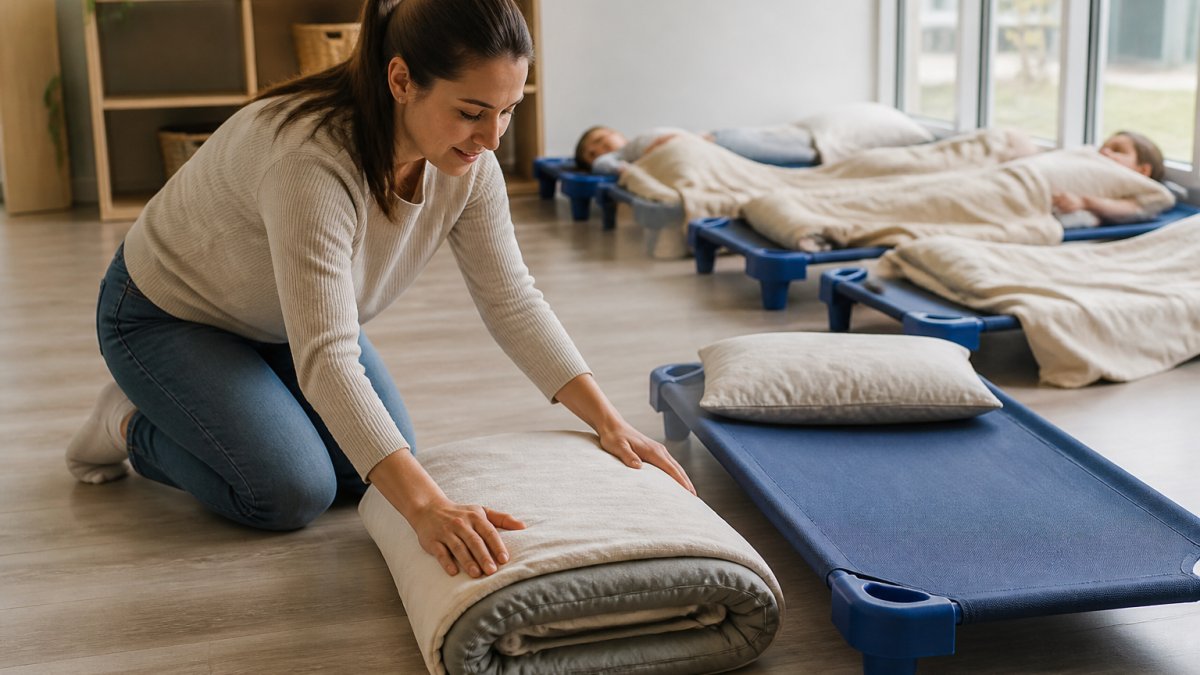
Setting up portable sleep solutions at daycare takes about ten minutes the first time and less once you have a routine. Here's how we'd do it.
Step 1: Confirm the policy. Get the centre's sleep policy in writing and check your chosen bedding against it. [Time: 10 minutes]
Step 2: Label everything. Name every piece, including the bag. Centres handle dozens of sets.
Step 3: Practise at home. Set the bedding up in your child's room and let them nap on it twice before daycare. [Time: 2 naps]
Step 4: Pack a named bag. Roll or fold the set the same way each time so your child recognises it.
Step 5: Brief the educator. Show them how it unfolds and where it stores. A short conversation saves weeks of confusion.
Step 6: Review after week one. Ask the educator how your child settled and adjust the setup if needed.
Expected Result: Your child has a consistent, familiar sleep surface at daycare, and the educator knows exactly how to set it up.
Common Mistakes to Avoid with Portable Sleep Solutions
The most common mistake is buying before checking the centre's policy. It's also the most expensive one, because a rejected set has no second use.
Others we see often:
- Buying one set only. One set means one wash cycle away from a problem.
- Skipping the home trial. A child who has never seen the bedding won't settle on it in a new room.
- Ignoring drying time. A set that takes two days to dry doesn't survive weekly washing.
- Overcomplicating the pack. If it takes five minutes to fold, it won't get folded.
- Forgetting the label. Unlabelled bedding goes missing, and centres can't be expected to track it.
The Raising Children Network offers practical guidance on sleep routines for young children, and the consistency principle applies at daycare as much as at home. The National Sleep Foundation also notes that familiar sleep cues help children settle in unfamiliar environments.
Portable sleep solutions only work when the bedding, the routine, and the centre all line up. That's the part most guides skip, and it's the part that decides whether your child actually rests.
At Cozie Dozie Co., we build kindergarten bed and sheet sets from butter-soft recycled French linen with a waterproof PUL canvas backing, designed on Country and flat-packed for real family life. Free shipping applies Australia-wide, so getting started is straightforward.
Shop the Cozie Dozie Co. range and give your child the same familiar sleep surface, wherever the day takes them.
Frequently Asked Questions
What can children sleep on at daycare besides a nap mat?
Beyond standard foam nap mats, children can use foldable floor beds, portable toddler beds with a padded base, or a fitted sheet-and-blanket set layered over a centre-provided mattress. For children with sensory sensitivities, a linen bed set with a waterproof backing offers a familiar, breathable surface that reduces the shock of an unfamiliar floor. Check with your centre first, as most require bedding to be flat, washable and stored in a named bag.
How do I keep daycare bedding separate and hygienic?
Use a named drawstring bag for each child and wash bedding at least weekly, or daily during illness outbreaks. Choose easy-clean daycare bedding with a waterproof PUL backing so accidents don't soak through to the mattress. Ask the centre how bedding is stored during the day, ideally in a labelled cubby away from other children's items, and confirm their washing policy so your routine matches theirs.
Can children bring their own bedding to kindergarten?
Most centres allow it, and many encourage a familiar sheet set for children who struggle to settle. Confirm the centre's policy on size, storage and washing first. A portable toddler bed for daycare works best when it folds flat, fits the centre's sleep space and can be machine washed. Label every item clearly and keep the set consistent so your child recognises it as their rest space.
What should I look for in portable sleep solutions for a sensory-sensitive child?
Prioritise soft, breathable natural fibres, a flat stable base, and a consistent smell and texture your child already knows. A waterproof backing protects against accidents without adding crinkly noise. Avoid heavy plastic covers and strong detergents. Practise using the bedding at home for a week before daycare so the transition feels familiar, and ask staff to place it in the same spot each day.