

Last Updated: October 23, 2026
Quick Summary
The best portable sleep solutions for toddlers recreate the key signals of home: a consistent surface, a defined edge and a recognisable routine cue. Swags suit camping, floor beds suit indoor travel and sensory-sensitive children, and travel cots suit families who need containment.
- Check four things before buying: safe sleep surface, portability, washability and sensory familiarity.
- Unpack a new travel bed at home a week before your trip and air it out in the shade.
- Set the bed up at home for a few daytime rests so it feels familiar.
- Keep your away-from-home routine to three or four steps in the same order.
- Set up the sleep space before bedtime, not at it, and stay close for the first settle.
Table of Contents
- What Makes a Portable Sleep Solution for Toddlers Work
- How to Choose a Travel Bed for a Toddler
- Toddler Travel Bed Options Compared: Swags, Floor Beds and Cots
- Toddler Travel Sleep Tips for Unfamiliar Rooms
- Building a Toddler Sleep Routine Away from Home
- Common Mistakes to Avoid with Portable Sleep Solutions
- Conclusion
- Frequently Asked Questions
What Makes a Portable Sleep Solution for Toddlers Work
A portable sleep solution for toddlers works when it recreates the key signals of home: familiar texture, a defined edge, and a consistent sleep cue. Portable sleep solutions are travel-ready bedding and sleep environments that give a toddler a recognisable place to rest in an unfamiliar room.
That definition matters more than it sounds. Most travel sleep gear fails not because it's badly made, but because it doesn't give a toddler enough sensory information to feel settled. A strange room smells different, echoes differently, and has no familiar boundaries.
At Cozie Dozie Co., we design around that gap. Our sensory floor beds and kids' swags use butter-soft recycled French linen with a waterproof PUL canvas backing, so the surface feels familiar whether it's on a hotel carpet or inside a tent.
The three things that make the difference:
- A consistent surface. Same fabric, same feel, every trip.
- A defined edge. Toddlers settle better when the sleep space has a clear boundary.
- A recognisable routine cue. The bed itself becomes the signal that sleep is coming.
Get those three right and the room matters far less than you'd expect.
How to Choose a Travel Bed for a Toddler
Choosing a travel bed for a toddler comes down to four checks: safe sleep surface, portability, washability, and sensory familiarity. Run each option against all four before you buy.
Here's how we'd work through it:
- Check the sleep surface. Firm and flat beats soft and padded. A toddler needs a surface that won't let them sink or roll into a gap.
- Check the folded size and weight. Measure your boot space and your luggage allowance before anything else.
- Check how it washes. Toddlers spill things. A cover that comes off easily and survives a hot wash is worth more than any extra feature.
- Check the sensory feel. Rough seams, noisy fabrics, and strong manufacturing smells are all reasons a child will refuse to lie down.
Materials, Safety and Sensory Considerations
Fabric choice is where most buying decisions go wrong. Linen breathes well and softens with every wash, which matters for a child who is sensitive to texture. Synthetic covers can feel clammy and often carry a chemical smell out of the packaging.
Look for a waterproof backing rather than a separate plastic sheet. A backing keeps accidents contained without adding a crinkly layer that wakes a light sleeper.
Safety basics apply wherever you are: a firm, flat surface, no loose bedding around a toddler's head, and the bed positioned away from cords, heaters, and unguarded edges. Follow the Product Safety Australia guidance on safe sleeping for the current recommendations.
Toddler Travel Bed Options Compared: Swags, Floor Beds and Cots
Swags, floor beds, and travel cots each solve a different problem, and no single type wins across the board. Swags suit camping and rough ground, floor beds suit indoor travel and sensory-sensitive children, and cots suit families who need containment.
| Option | Best For | Portability | Washability | Watch Out For |
|---|---|---|---|---|
| Kids' swag | Camping, road trips, outdoor use | Rolls or folds compactly | Cover removes for washing | Needs a mat underneath on rough ground |
| Sensory floor bed | Hotels, family stays, daycare | Flat-packs, light to carry | Removable linen cover | Needs a clear floor space |
| Travel cot | Toddlers who climb out of beds | Bulky, heavier to pack | Wipe-clean, harder to launder | Can feel unfamiliar and cold |
Swags are the best choice for camping families. They handle uneven ground and keep a toddler off cold earth. The trade-off is that a swag on hard ground still needs a mat underneath for comfort.
Floor beds win for indoor travel. A flat, low bed with a defined edge gives a toddler the boundary they're looking for without the climb-out risk of a cot. Our sensory floor beds are designed exactly for this: flat-packed for the car, quick to set up, and made from breathable recycled linen.
Travel cots suit families who need a child contained. Where they fall short is familiarity. A mesh-sided cot feels nothing like home, and many toddlers protest loudly for the first two nights.
Toddler Travel Sleep Tips for Unfamiliar Rooms
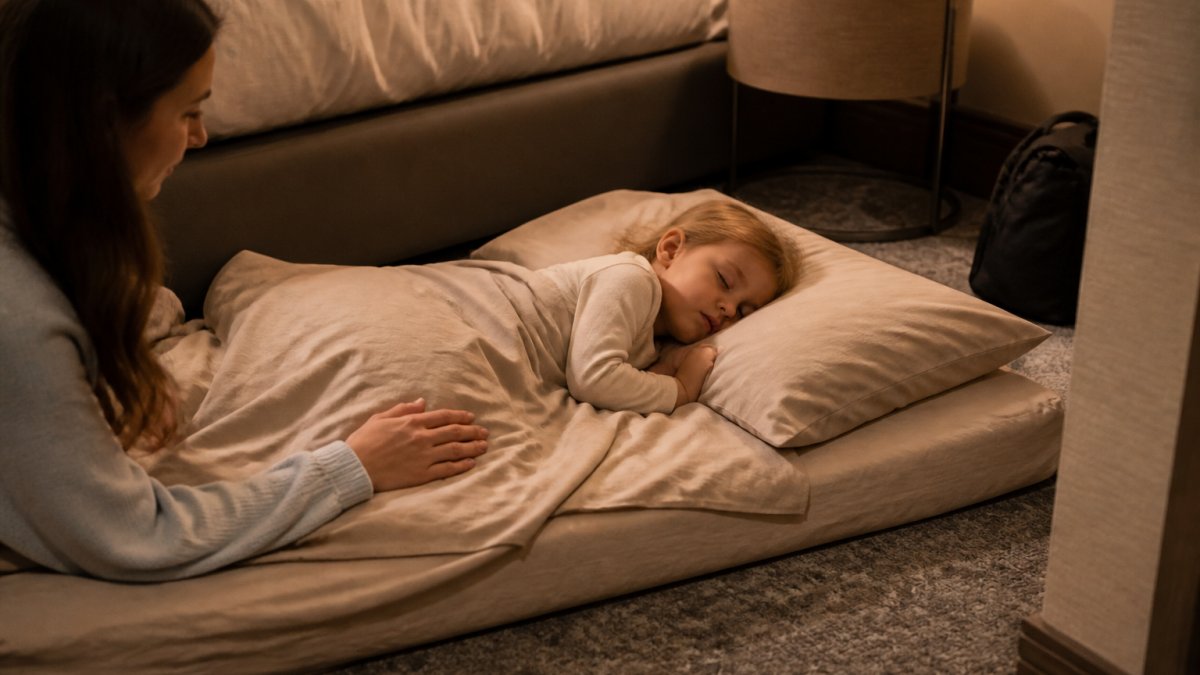
Unfamiliar rooms unsettle toddlers because every sensory cue has changed at once. Reduce the number of changes and most children adapt within a night or two.
What works in practice:
- Bring the familiar. The same pillow, the same sleeping bag, the same book. Pack the bed itself if you can.
- Set up before bedtime, not at it. Let your toddler explore the sleep space while it's still light and the room feels safe.
- Keep the room dark and quiet. A portable white noise machine masks corridor noise and unfamiliar sounds.
- Recreate the edge. If your toddler sleeps with a boundary at home, give them one away too.
- Stay close for the first settle. Sit nearby until they're drowsy, then step back gradually over the following nights.
A common mistake is over-stimulating the room. Too many toys, too much light, and a screen on before bed all work against you. Treat the sleep space as a calm zone from the moment you arrive.
Building a Toddler Sleep Routine Away from Home
A toddler sleep routine away from home should mirror the one you use at home, in the same order, at roughly the same time. The location changes; the sequence doesn't.
Keep it to three or four steps and write them down before you travel:
- Bath or wash
- Pyjamas and sleeping bag
- One book in the sleep space
- Lights down, same phrase, same cuddle
The order is doing the work. A toddler who hears the same words in the same sequence gets the same wind-down signal, whether they're in their own room or a cabin. Time zones and late drives will shift the clock, so anchor on the sequence rather than the exact hour.
Common Mistakes to Avoid with Portable Sleep Solutions
Most portable sleep solutions fail for predictable reasons, and nearly all of them are avoidable with a bit of planning. Here are the ones we see most.
Buying on size alone. A bed that packs small but feels unfamiliar won't get used. Check the surface and the fabric before the folded dimensions.
Skipping the trial run. Set the bed up at home for a few daytime rests. A toddler who has already napped on it will accept it far more readily in a hotel.
Overpacking the sleep space. Familiarity means one or two comfort items, not a toy box. Clutter keeps a toddler alert.
Ignoring washability. Travel means spills, sand, and mud. A cover that can't be removed and washed will shorten the product's life fast.
Forgetting the boundary. Toddlers who sleep with an edge at home often roll out of an open bed away. Recreate the boundary.
Leaving setup to bedtime. Arriving late and assembling a bed in a dark room while a tired toddler watches is a recipe for a hard night. Set up first, settle later.
If you're weighing up a supermarket travel set against a purpose-made option, the difference usually comes down to materials and longevity. Recycled French linen softens with washing rather than pilling, and a waterproof backing means the bed survives the trips that matter. Pricing depends on the product and any current offers, so check our website for the latest details.
Conclusion
Travel sleep is rarely perfect, and the first night away is usually the hardest. The families who manage it well aren't doing anything clever. They're bringing a familiar surface, keeping the routine identical, and setting up before bedtime rather than at it.
That's what we build for at Cozie Dozie Co. Our sensory floor beds and kids' swags give your toddler a consistent, calming space wherever you land, made from butter-soft recycled French linen with a waterproof PUL canvas backing. They flat-pack for the car, wash easily, and ship free Australia-wide.
Get started with Cozie Dozie Co. and give your little one the same safe, familiar place to rest, wherever the trip takes you.
Frequently Asked Questions
What is the best portable bed for a toddler?
The best portable sleep solution depends on your child's sensory needs and how you travel. A toddler travel bed with a familiar, breathable surface and a defined edge often settles children faster than an open mattress on the floor. Look for washable covers, a waterproof backing and a compact packed size. Families who camp or road trip tend to favour swags and floor beds over inflatable options, because they hold their shape and feel consistent night after night.
Are inflatable toddler beds suitable for travel?
Inflatable toddler beds are light and pack down small, but they come with trade-offs. They can feel unstable under a restless sleeper, they lose air over time and some children find the plastic surface overstimulating. If you choose one, test it at home for a few nights first and add a familiar sheet or blanket. For children with sensory sensitivities, a firmer floor bed or swag with natural fabric usually provides more predictable feedback.
How do I choose a travel bed for a toddler?
Start with the surface: natural, breathable fabrics such as linen help regulate temperature and feel familiar. Check the base for a waterproof backing so accidents do not ruin the trip. Measure your car boot and luggage before buying, and weigh the packed item against what you can realistically carry. Finally, confirm the bed sits flat on the floor with no gaps where a small limb could become trapped, and that any cover is machine washable.
How can I make a toddler's travel bed feel familiar?
Bring the same pillow, sleeping bag or comforter your child uses at home, and set the bed up in the same position relative to the door as their bedroom if possible. A small nightlight and a consistent bedtime song help signal that this is sleep time. If your child uses a floor bed at home, choose a portable option with a similar low profile so the change feels smaller. Consistency matters more than a perfect setup.
