

Last Updated: November 17, 2026
Quick Summary
The best alternatives to plastic kindergarten nap mats are natural fabric options such as linen, cotton and hemp, plus washable floor beds and flat-packed covers you fill yourself. Choose a mat with a removable, machine-washable cover and a waterproof backing, and confirm your centre's cot dimensions and mat policy before ordering.
- Linen breathes best and handles humidity better than cotton, while hemp is the toughest but costs more.
- Filled pocket loungers typically cost $179.95 to $189.95 and last three to five years with regular washing.
- A non-removable cover means washing the whole mat, which can take a full day to dry in humid weather.
- Ask your centre for its written mat policy, as some services allow only flat cot sheets.
- Buying before confirming cot dimensions and material policy is the most common mistake we see.
Table of Contents
- Why Parents Are Moving Away From Plastic Nap Mats
- How to Choose a Nap Mat for Daycare: A Practical Checklist
- Natural Fabric Nap Mat for Daycare: Linen, Cotton and Hemp Compared
- Non-Plastic Nap Mat Options Compared
- What Makes a Washable Childcare Sleep Mat Worth Buying
- Sensory-Friendly Floor Bed for Children: Matching the Mat to Your Child
- Australian Safety Checks and Kindergarten Approval
- Choosing Your Child's Nap Mat at Cozie Dozie Co.
- Frequently Asked Questions
Why Parents Are Moving Away From Plastic Nap Mats
Plastic kindergarten nap mats have been a daycare staple for decades, but a growing number of Australian parents are looking for alternatives. Many parents voice the same concerns: the clammy feel of PVC vinyl against a child's skin, the crinkle of synthetic fabric at rest time, and the nagging question of what those materials are made from. In humid summers, plastic mats can feel sticky and slow to dry.
The shift is practical as much as philosophical. Plastic mats can trap heat, which makes them uncomfortable in warmer weather. Their surfaces can crack and peel with age. And many parents now ask what a mat is made from before they ask what it costs.
Below, we break down eight alternatives to plastic kindergarten nap mats, from natural fabric options to washable floor beds, plus the checks that matter when you're buying for daycare or kindy.
How to Choose a Nap Mat for Daycare: A Practical Checklist
Choosing a nap mat for daycare comes down to five checks: fabric safety, size and fit, washability, breathability, and whether your centre will accept it. Get those right and the rest is detail.
Here is the checklist we would run through before buying:
- Fabric: Natural or recycled fibres, ideally with no flame-retardant or PFAS finishes
- Size and fit: Confirm the mat or cot sheet matches your centre's cot dimensions
- Washability: Removable, machine-washable covers; check the care label before buying
- Breathability: Natural fibres that won't trap heat against the skin
- Water resistance: A waterproof backing for accidents and damp floors
- Portability: Lightweight enough to fold, carry and store in a bag or locker
- Centre approval: Ask whether the kindy has rules about mat type, thickness or storage
For a deeper look at what separates a good set from a great one, our guide on best daycare bedding sets covers the details in full.
Natural Fabric Nap Mat for Daycare: Linen, Cotton and Hemp Compared
Natural fabric nap mats for daycare fall into three main camps: linen, cotton and hemp. Each behaves differently against skin, and each dries at a different rate.
Linen is the coolest of the three. It breathes well, feels soft after a few washes, and handles humidity better than cotton. Recycled French linen, which is used in the Cozie Dozie range, keeps that breathability while giving old fabric a second life.
Cotton is the familiar choice: soft, absorbent and easy to wash. It's a solid option, though it holds moisture longer than linen and can feel heavy in summer.
Hemp is the toughest of the three and softens with age. It's durable and breathable, but it takes longer to break in and tends to cost more.
If you're weighing up recycled linen specifically, our parent's guide on why choose recycled linen for kids explains the material in more depth.
Non-Plastic Nap Mat Options Compared
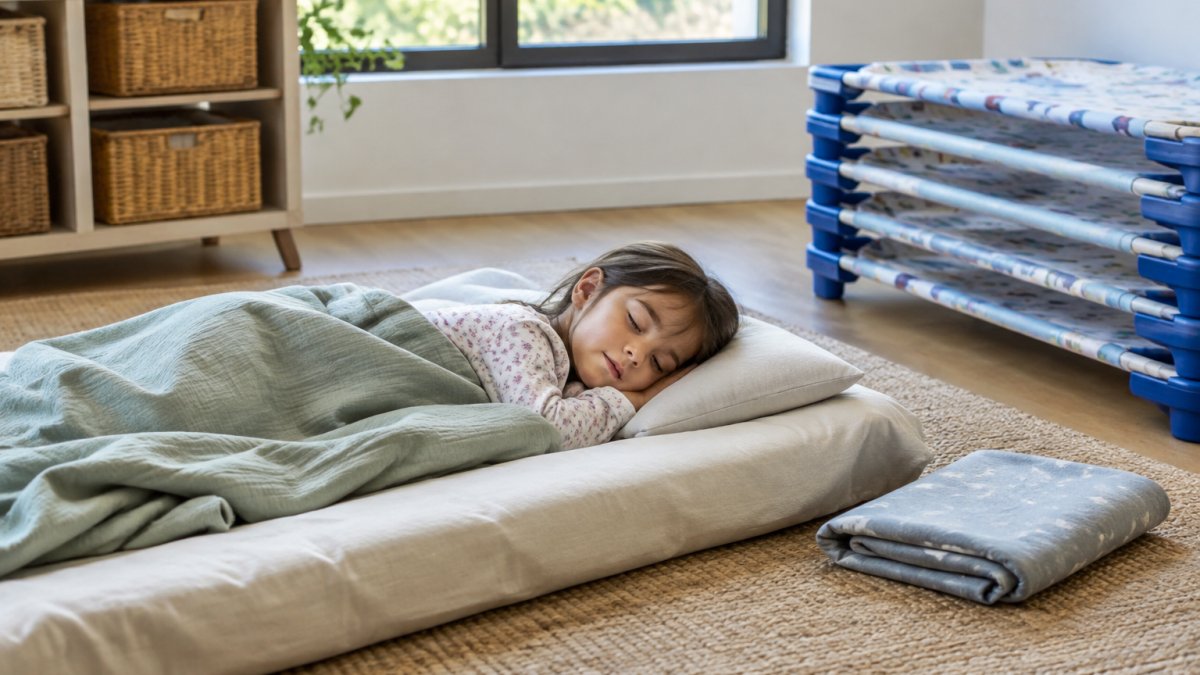
Non-plastic nap mats generally fall into four types: filled pocket loungers, flat-packed covers you fill yourself, quilted cotton mats, and foldable foam mats with fabric covers. The table below compares them on what matters for daily daycare use.
| Type | Fill | Washability | Breathability and drying | Durability | Best For | Typical Cost (AUD) |
|---|---|---|---|---|---|---|
| Filled pocket lounger | Recycled polyester pillows | Cover detachable, machine washable | Good airflow through linen or cotton top; dries in a few hours in sun | 3-5 years with regular washing | Daily kindy use, travel | $179.95-$189.95 |
| Flat-packed cover | Your own pillows or foam | Fully washable top sheet | Depends on fill; cover dries fast | 2-4 years; fill may need replacing | Families wanting flexibility | $129.95-$139.95 |
| Quilted cotton mat | Cotton wadding | Machine washable | Breathable but holds moisture longer than linen | 2-3 years; wadding can clump | Light occasional use | $60-$120 |
| Foam mat with fabric cover | Foam core | Cover removable | Foam traps heat; cover dries but core may stay damp | 1-3 years; foam compresses | Budget option | $40-$90 |
Typical Cost (AUD)
Filled pocket loungers arrive ready to use. Flat-packed covers let you fill them with pillows you already own. Quilted cotton mats are light and simple. Foam mats with fabric covers are a lower-cost option.
A linen or cotton cover with a waterproof PUL backing and a removable fill is one practical combination, because the cover can be removed and washed after an accident.
Watch out: buying a mat with a non-removable cover means washing the whole mat, which can take a full day to dry in humid weather and leave you without a mat for kindy the next morning.
Confirm the mat's dimensions against your centre's cot before ordering, and check the retailer's returns policy if the size is wrong.
What Makes a Washable Childcare Sleep Mat Worth Buying
A washable childcare sleep mat is worth buying when the cover comes off completely, the fabric survives repeated hot washes, and the mat dries quickly between uses. Anything less becomes a chore.
Look for a fully detachable top sheet rather than a mat you have to wash whole. A removable cover means you can strip it after a messy day and wash it separately from the fill.
A waterproof backing is the other half of the equation. It stops dampness from the floor reaching the fabric, which keeps the mat fresher for longer. For step-by-step washing guidance, see our article on how to wash daycare bedding safely.
Sensory-Friendly Floor Bed for Children: Matching the Mat to Your Child
A sensory-friendly floor bed for children works best when it matches how your child settles: some need weight and pressure, others need a soft, predictable surface with no rustle or texture surprises. The mat you choose should support that.
Some children with sensory sensitivities are sensitive to synthetic textures and the sound of plastic underfoot. Many families find natural fibres feel softer against skin, and a mat that stays put on the floor gives a predictable resting space.
You can add a folded blanket under the cover for a firmer surface, or a second pillow in the top pocket for more cushioning.
Australian Safety Checks and Kindergarten Approval
Safety checks for nap mats generally focus on fabric finishes, fit, and your centre's own rules. The following checklist covers points to consider before you buy.
Fabric and finish checks
- Ask the manufacturer directly whether the fabric has flame-retardant or PFAS finishes. Many Australian parents prefer untreated natural fibres, but confirm the care label and any claims in writing.
- Look for a mat with no sharp edges, loose threads, or small parts that could detach, and a label stating age suitability and care instructions.
Size and fit checks
- Confirm the mat or cot sheet dimensions against your centre's cot. Kindy cot sizes vary between centres. Measure the cot yourself or ask the director for the exact internal dimensions.
- Check thickness, as some centres have their own limits for storage and safety.
Centre approval steps
- Ask your centre for their written policy on nap mats, including material rules, storage requirements, and hygiene expectations. Some centres require a named mat that stays at the service.
- Confirm whether the centre allows filled loungers or only flat cot sheets. Some services prefer flat sheets for easy sanitising.
- Ask about labelling: most centres require the child's name clearly marked on the mat and any bag.
Storage and hygiene
- Check whether the mat folds or rolls small enough for the centre's storage. A mat that doesn't fit the cubbyhole will be sent home.
- Confirm the cover's care label if the centre has hot-washing requirements.
Watch out: buying a mat before confirming your centre's cot dimensions and material policy is the most common mistake we see. A mat that doesn't fit or isn't approved gets sent home and stays there.
Before ordering, call your centre and ask for their written mat policy. If you're ordering online, confirm the retailer's returns policy for incorrect size, and keep the packaging until the centre has approved the mat.
Choosing Your Child's Nap Mat at Cozie Dozie Co.
Choosing your child's nap mat at Cozie Dozie Co. means picking a design built for rest, not a plastic sheet that fights it. Our flat-packed loungers use a butter-soft recycled French linen top sheet over a waterproof PUL canvas backing, and shipping is free Australia-wide. Fill the pockets with pillows you already own, or choose a filled option that arrives ready to use.
Our Colour of Country Joey works as a kindy cot sheet set: fill the top pocket with one pillow and leave the rest flat. The Buck gives bigger kids and adults a full 3 metres to stretch out, and the Limited Edition Joey pairs a recycled linen top with a waterproof canvas base for damp grass and campsites.
Browse the Colour of Country Collection to find the right design. If you have questions, visit our help page.
Plastic mats have had a long run, but they're no longer the only option. If you want a nap mat that breathes, washes well and feels gentle against your child's skin, Cozie Dozie Co. has you covered. Our recycled French linen loungers are designed on Country, built with a waterproof PUL backing and shipped free Australia-wide. Get started with Cozie Dozie Co. and give your little one a calmer place to rest.
Frequently Asked Questions
What can I use instead of a plastic kindergarten nap mat?
The most practical swaps are fabric-covered loungers and cot sheet sets filled with pillows, foam or bedding you already own. Look for a natural fibre top sheet such as recycled French linen or cotton, paired with a water-resistant backing so damp floors do not soak through. A pocket-style cover that takes standard pillows is versatile because you control the loft and firmness. Check that the cover is fully detachable and machine washable, and confirm the size fits your childcare service's cot or rest area before you buy.
Are fabric nap mats suitable for kindergarten and childcare?
Yes, provided they meet the service's rest-time requirements. Many kindergartens ask for a named, washable mat or cot sheet set that stores flat and can be cleaned between uses. Fabric covers with a water-resistant PUL backing handle spills and damp floors without the stiffness of PVC. Ask your centre whether they require a specific size, whether bedding must fit inside a named bag, and how often items go home for washing. A flat-packed lounger that folds into a cot sheet set is usually the easiest to store.
What is the best natural material for a children's nap mat?
Linen and cotton are the most common choices. Linen is breathable, softens with every wash and dries faster than heavy cotton, which matters in humid Queensland weather. Cotton is cheaper and widely available but can stay damp longer. Hemp is durable but starts rougher. For sensitive skin, look for a smooth, butter-soft top sheet and a backing that keeps moisture away from the body. Avoid vague 'organic' claims without a certification, and ask what the fabric is actually made from before buying.
How do I choose a nap mat for a child with sensory sensitivities?
Prioritise familiarity and predictability over novelty. A mat that feels the same at kindy as it does at home helps a child settle, so choose one fabric and stick with it. Look for smooth seams, no scratchy tags, a weight the child finds calming rather than restrictive, and a size that gives clear boundaries. A pocket-style lounger filled with a single pillow creates a defined, low-profile resting space. Test it at home for a week of quiet time before sending it to daycare.
