

Last Updated: November 1, 2026
Quick Summary
ErgoPouch vs SlumberPod is not a direct contest because they solve different problems: ErgoPouch makes wearable sleep bags that keep a child warm and contained, while SlumberPod makes a portable blackout tent that darkens a sleep space. Most travelling families need both warmth and darkness, so neither product delivers everything alone.
- ErgoPouch packs flat and is light to carry, while SlumberPod folds into a bulkier carry bag.
- Check ventilation, fit, assembly and supervision before using a SlumberPod with a toddler bed.
- The best portable blackout tent blocks light fully, ventilates well and packs small.
- Recreate home cues when travelling: same sleepwear, darkness, routine and familiar sleep surface.
- Match the tog rating to room temperature to avoid overheating in a sleep bag.
Table of Contents
- ErgoPouch vs SlumberPod: Two Different Jobs for Travel Sleep
- Toddler Travel Bed Comparison: What Each Option Actually Does
- Using a SlumberPod with Toddler Bed Setups
- Choosing a Portable Blackout Tent for Toddler Travel
- How to Help a Toddler Sleep While Travelling
- Common Mistakes Parents Make with ErgoPouch vs SlumberPod
- Building a Travel Sleep Setup That Works for Your Child
- Frequently Asked Questions
ErgoPouch vs SlumberPod: Two Different Jobs for Travel Sleep
ErgoPouch vs SlumberPod is not really a contest, because the two products solve different problems. ErgoPouch makes sleep bags and wearable blankets that keep a child warm and contained. SlumberPod makes a portable blackout tent that darkens a sleep space. Comparing them directly is like comparing a duvet to a curtain.
This is a question many families ask when packing for a trip. The honest answer: most travelling families need a warm, familiar sleep surface and a way to block light, and neither single product delivers both.
Below, we break down what each option actually does, where each falls short, and how to build a setup that works for your child.
Toddler Travel Bed Comparison: What Each Option Actually Does
A quick definition helps here. ErgoPouch is a brand of wearable sleep bags and swaddles designed to keep a child warm without loose bedding. SlumberPod is a portable blackout tent that fits over a cot or travel bed to create a dark, enclosed sleep space.
So the toddler travel bed comparison is really a comparison of jobs: temperature and containment versus darkness and enclosure. Neither is a bed on its own. Both are add-ons to whatever your child sleeps on.
Blackout, portability, safety and washability at a glance
| Feature | ErgoPouch | SlumberPod |
|---|---|---|
| Primary job | Warmth and containment | Blackout and enclosure |
| Portability | Packs flat, light to carry | Folds into a carry bag, bulkier |
| Blackout | None | Full blackout panels |
| Safety considerations | Correct tog rating for room temperature | Ventilation and fan access matter |
| Washability | Machine washable, check care label | Spot clean and air dry typically |
| Works with a toddler bed | Yes, as sleepwear | Yes, if sized to the bed |
| Best for | Cold rooms, familiar sleepwear | Bright rooms, shared spaces |
The table makes the split obvious. If your child wakes at 5am because the holiday cabin has thin curtains, ErgoPouch won't fix that. If your child kicks off blankets in a cold caravan, SlumberPod won't fix that either.
Using a SlumberPod with Toddler Bed Setups
Pairing a SlumberPod with a toddler bed setup works, but only if the tent matches the bed. A portable blackout tent for toddler travel is usually designed around a cot or a compact travel bed, so check the internal dimensions before you buy.
Here is what we would check first:
- Ventilation: the tent needs airflow, and most models rely on a fan port. Confirm your child can breathe comfortably and the room stays cool.
- Fit: the tent should sit over the bed without pressing on your child or blocking the mattress.
- Assembly: practise putting it up at home before you travel. Fiddly setups at 9pm in a strange room are miserable.
- Supervision: treat the tent as an enclosure, not a babysitter. Younger toddlers need checking.
Watch out: buying a tent sized for a cot and then trying to stretch it over a larger floor bed. It won't fit properly, and a sagging tent can collapse onto a sleeping child.
Choosing a Portable Blackout Tent for Toddler Travel
The best portable blackout tent for toddler travel is one that blocks light fully, ventilates well, and packs small enough for your car or suitcase. Those three factors matter most.
Our advice is to test the tent in your own home first. Set it up in a bright room at midday and see how dark it gets. Check whether the fabric feels breathable. Then fold it down and time how long it takes.
For families weighing broader options, our guide to the best portable sleep solution for toddlers compares the main approaches side by side. It helps to see where a blackout tent fits alongside wearable sleepwear and floor beds.
A common mistake is buying for the trip you're taking now rather than the trips you take most often. Campers need durability and packability. Hotel families need quick assembly and true blackout. Match the tent to your habits.
How to Help a Toddler Sleep While Travelling
To help a toddler sleep while travelling, recreate the cues they rely on at home: the same sleepwear, the same darkness, the same routine, and a familiar sleep surface. Consistency does more than any single gadget.
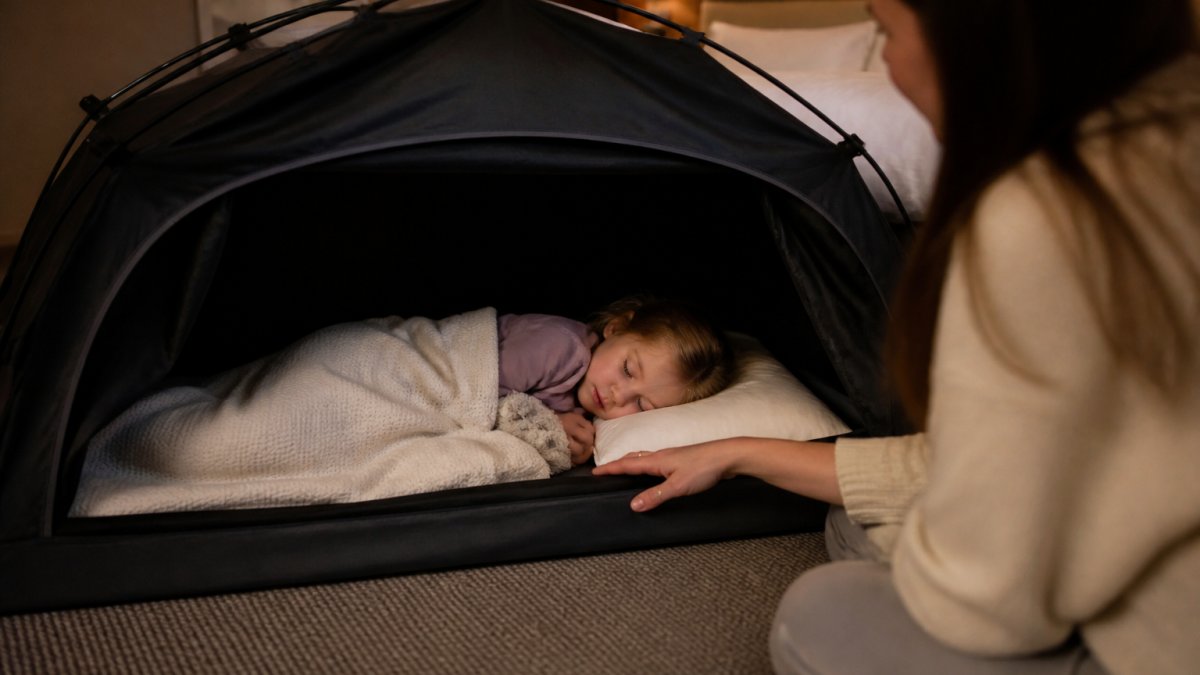
Start with the routine. Bath, book, dim lights, same order as home. Then control the environment: block light, manage temperature, and keep noise steady. Bring the sleep bag your child already knows, because unfamiliar sleepwear can unsettle a sensitive child.
For children with sensory processing differences, familiar textures matter enormously. If you're unsure whether specialist bedding is worth the outlay, read our take on whether special travel bedding is worth it for sensory kids. It covers when it genuinely helps and when a simpler setup is fine.
Common Mistakes Parents Make with ErgoPouch vs SlumberPod
The biggest mistake with ErgoPouch vs SlumberPod is treating them as alternatives when they solve different problems. Parents buy one, find it doesn't fix everything, and conclude it doesn't work.
Other mistakes we see:
- Wrong tog rating. A sleep bag that's too warm for a heated room causes overheating. Match the tog to the temperature.
- Skipping the home trial. Test any tent or sleep bag at home before relying on it away.
- Ignoring the sleep surface. Neither product replaces a comfortable, safe bed. The base matters.
- Overpacking. Families often bring several solutions when one familiar setup may be enough.
A common mistake is assuming a blackout tent will settle a child who is simply uncomfortable on a strange mattress. Fix the bed first, then the light.
Building a Travel Sleep Setup That Works for Your Child
The setup that works is the one your child recognises. Build it in layers: a safe, comfortable sleep surface, familiar sleepwear, blackout where needed, and a routine that travels with you.
A sensory floor bed can be a useful part of this setup. Our Colour of Country Collection offers sensory-safe children's floor beds. It gives a child a familiar, calming base wherever you stay.
If you're starting from scratch, our portable kids bed buying guide walks through what to look for, and our guide to what makes the best kids sleep environment for travel explains the environment side in more detail.
You can also reach out to Cozie Dozie Co. directly with questions about which setup suits your child.
Frequently Asked Questions
What is the difference between ErgoPouch and SlumberPod for travel?
They solve different problems. An ErgoPouch is a wearable sleep bag that keeps a toddler warm and contained, so it travels well but does not darken a room. A SlumberPod is a fabric blackout tent that fits over a travel cot or mattress to block light and create a private sleep space. Many families use both together: the bag for warmth and the tent for darkness. Your choice depends on whether light or temperature is the bigger disruption on your trip.
Can you use a SlumberPod with a toddler bed?
A SlumberPod is designed to sit over a travel cot or a low mattress rather than a full toddler bed. Check the manufacturer's height and mattress size limits before you pack it, because a bed that is too tall or too wide will not fit inside the fabric frame. For older toddlers who have moved to a bed, a portable blackout tent or a familiar linen bed set layered over a mattress can be a better fit.
How do you help a toddler sleep in a hotel or unfamiliar room?
Recreate the cues your child already knows. Bring the same sleep bag, pillow or linen bed set from home, block out light with a portable blackout tent or extra curtains, and keep the bedtime routine in the same order. White noise helps mask corridor sounds. Set up the sleep space during the day so your toddler can explore it before bedtime, and allow a night or two for adjustment. Consistency matters more than a perfect room.
Which is easier to pack, ErgoPouch or SlumberPod?
An ErgoPouch rolls or folds small and weighs very little, so it slips into a nappy bag or suitcase without effort. A SlumberPod packs into its own carry bag but takes up more room because of the frame and fabric panels. For camping or road trips with limited boot space, weigh the packed size against how much light you expect to deal with. If your accommodation already has blockout blinds, the bag alone may be enough.
Travel sleep rarely goes to plan on the first night, and that's normal. The families who settle fastest are the ones who bring a familiar, sensory-safe base and build the rest around it. At Cozie Dozie Co., our sensory floor beds, recycled French linen covers and flat-packed designs are made for exactly this: a portable, calming space a child recognises. Get started with Cozie Dozie Co. and give your little one a familiar place to rest, wherever the road takes you.
