

Last Updated: 25 October 2026
Quick Summary
Sensory-friendly travel bedding is sleep equipment designed to reduce sensory triggers rather than just cover a mattress, controlling what a child feels, smells and recognises in an unfamiliar space. Look for a natural fibre with a soft, broken-in hand feel, no scratchy seams and a backing that blocks moisture, then trial it at home before you travel.
- Synthetic sheets trap heat and create a clammy feel many sensory kids cannot tolerate.
- Use the travel bedding for a week of day naps at home before the first trip.
- The sheet is the only surface your child's skin touches all night, so choose it first.
- A good portable bed sets up in under five minutes with no tools.
- Set up the sleep space on arrival, not at bedtime, so your child explores it calm.
Table of Contents
- Why Standard Travel Bedding Fails Sensory Kids
- What to Look for in Sensory-Friendly Travel Bedding for Kids
- Travel Sheets for Kids: Why the Sheet Matters More Than the Mattress
- Choosing a Portable Kids' Bed for Travel That Actually Packs Down
- Sensory-Friendly Sleep Away from Home: Building a Settling Routine That Travels
- Mistakes Parents Make When Buying Travel Bedding
- Choosing Your Child's Travel Bedding Setup
- Frequently Asked Questions
Why Standard Travel Bedding Fails Sensory Kids
Most travel bedding sold in Australia is built for convenience, not for children whose nervous systems process touch, smell and change differently. A standard portacot mattress with a polyester sheet feels slick, rustles with every movement, and holds an unfamiliar smell from the last hotel laundry. For a sensory-sensitive child, that is not a small annoyance. It is a full-body alarm that keeps firing all night.
At Cozie Dozie Co., we hear the same story from families across Mount Larcom, QLD and beyond: the child settles beautifully at home and then fights sleep for hours in a caravan, cabin or grandparent's spare room. The bedding is usually the first thing to blame, and the last thing parents change.
Sensory-friendly travel bedding is sleep equipment designed to reduce sensory triggers, not just cover a mattress. It controls what a child feels, smells and recognises, which is exactly what a dysregulated nervous system needs in an unfamiliar space.
Three things go wrong with ordinary travel bedding:
- Synthetic sheets trap heat and create a clammy feel that many sensory kids cannot tolerate
- New textures and smells arrive all at once, with nothing familiar to anchor to
- Loose or crinkly covers shift during the night, waking a light sleeper repeatedly
None of this is about softness or thread count. It is about predictability.
What to Look for in Sensory-Friendly Travel Bedding for Kids
Start with the two factors that decide whether a child settles: how the fabric feels against skin, and whether the setup cues the same sleep response as home. Everything else is secondary.
Fabric and Feel
Fabric is the first filter, and it rules out most of what is on the shelf. Look for a natural fibre with a soft, broken-in hand feel, no scratchy seams against the face, and a backing that will not let moisture through to the mattress underneath.
Linen is a strong candidate because it softens with every wash and breathes well in warm weather, which matters on a Queensland summer night in a tent. If you are weighing up options, our guide to the benefits of French linen for toddlers explains how the fibre behaves against sensitive skin. Parents comparing materials also ask us about why recycled linen is a good choice for kids.
Watch out: a fabric can feel lovely in the shop and still fail at 2am if it holds heat or creases into ridges under a restless sleeper. Wash it before you travel, so the first night away is not also the first night in that fabric.
Familiarity and Routine Cues
Familiarity does more work than most parents expect. A child who recognises the sheet, the weight of the cover and the smell of home bedding settles faster because the brain reads the setup as safe.
Build that recognition deliberately:
- Use the travel bedding for a week of day naps at home before the first trip
- Keep the same pillow, sleep toy and sheet across every location
- Pack a worn-in layer rather than something fresh from the packet
- Repeat the same three or four settling steps in the same order, every time
The goal is a portable signal that tells your child's body sleep is coming, regardless of whether they are in Mount Larcom or a cabin four hours west.
Travel Sheets for Kids: Why the Sheet Matters More Than the Mattress
The sheet is the only surface your child's skin touches all night. Parents spend hours researching mattresses and then cover them with whatever came in the box.
That is backwards. A good mattress under a crinkly, sweaty synthetic sheet still produces a restless night. A modest mattress under a soft, familiar, breathable sheet often settles a child within minutes. The sheet is the interface, and interfaces decide comfort.
Practical checks before you buy:
- Does the sheet fit tightly, with no loose fabric to bunch under a rolling child?
- Is there a waterproof layer, so an accident does not end the trip at midnight?
- Can it be machine washed and dried quickly between stops?
- Does it feel the same after ten washes as it did on night one?
For families who have already decided the sheet is the key purchase, our guide to buying sustainable kids travel sheets walks through what to check before you commit.
Choosing a Portable Kids' Bed for Travel That Actually Packs Down
A portable kids' bed for travel has to do two jobs that pull against each other: feel secure enough to sleep in, and fold small enough to actually take. Most products pick one and fail the other.
Here is how we would judge any option before buying:
| What to check | Why it matters | What good looks like |
|---|---|---|
| Packed size and weight | Boot space and lifting in and out of the car | Fits in a standard boot alongside luggage |
| Setup time | Late arrivals with a tired child | Under five minutes, no tools |
| Ground clearance | Cold floors, damp ground, draughts | Raised or insulated base |
| Washability | Accidents, sand, food | Machine washable cover |
| Familiarity cues | Settling in a new room | Consistent with home bedding |
Flat-packed designs that use the same sheet and cover as home score best on that last row, because the child is not learning a new setup at the worst possible moment.
Sensory-Friendly Sleep Away from Home: Building a Settling Routine That Travels
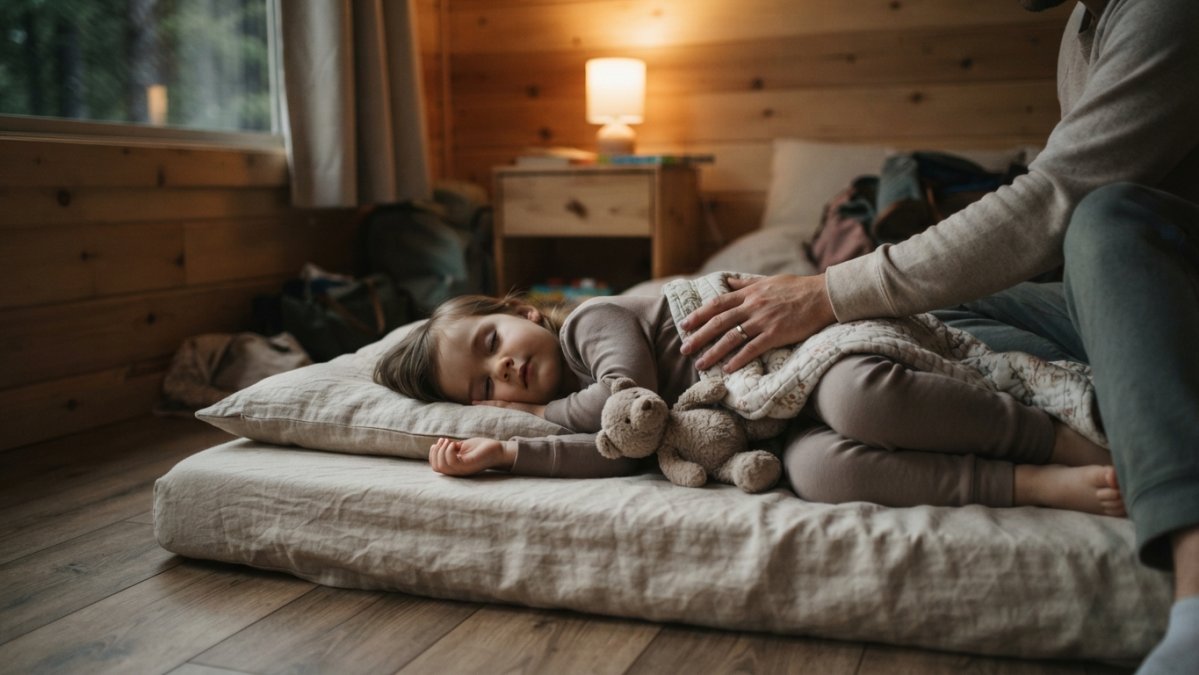
Sensory-friendly sleep away from home comes down to reducing novelty, not adding comfort items. The fewer new sensations a child meets at bedtime, the faster their body accepts the change.
A routine that travels well looks like this:
- Set up the sleep space as soon as you arrive, not at bedtime, so the child can explore it while calm
- Keep the same wash, pyjamas, story and lights-out order as at home
- Dim the room early and cut screen exposure an hour before bed
- Stay close for the first ten minutes, then step back gradually
- Use the same phrases every night, in every location
Two mistakes undo this quickly. Changing the routine because you are on holiday, and leaving setup until the child is already overtired. Both hand the nervous system extra work at exactly the wrong time.
For children who need deep pressure to settle, a floor-level bed with weight and resistance under them often works better than a raised cot. A parent's hand on the back, a heavy blanket in cool weather, and a firm surface beneath all help regulate a body that struggles to switch off.
Mistakes Parents Make When Buying Travel Bedding
The same errors show up again and again, and each one is avoidable.
Buying for the trip, not for the child. A product that reviews well for neurotypical toddlers may be exactly wrong for a child who cannot tolerate seams, tags or synthetic textures.
Skipping the trial run. First use should never be the first night of a holiday. Test at home, during the day, with no pressure to sleep.
Ignoring the wash cycle. Travel bedding gets dirty fast. Anything that needs delicate washing or slow drying will be a problem by day three.
Assuming price equals suitability. Expensive gear can still be the wrong fabric, the wrong size or the wrong setup for your child. Match the product to the sensory need first.
Forgetting the rest of the family. A setup that only works for one child creates friction on every trip. Check packed dimensions and weight against your actual car and luggage before you buy.
Not asking how it is made. If sustainability matters to you, ask where the product is made and how the material is sourced before you spend. A brand that cannot answer that question clearly is telling you something.
Choosing Your Child's Travel Bedding Setup
Build the setup in layers, and buy in the order that affects sleep most. Our best portable sleep solutions for toddlers roundup helps you finalise the setup.
Start with the sheet and cover, because that is the surface your child actually feels. Add a portable bed that packs down and sets up fast. Then add the routine cues: the same pillow, the same sleep toy, the same sequence of steps.
For families near Mount Larcom and across regional QLD, the practical test is simple: can you pack it, set it up and wash it without stress, on a road trip, with tired kids in the car? If the answer is yes, you have found the right setup.
Getting sleep right away from home is one of the hardest parts of travelling with a sensory-sensitive child, and it is the problem we built Cozie Dozie Co. around. Our kids' bed and sheet sets are made from butter-soft recycled French linen with a waterproof PUL canvas backing, flat-packed for the car and designed as a sensory-safe space that travels. Free shipping Australia-wide means regional families are not penalised for where they live. Get started with Cozie Dozie Co. and give your child the same calm, familiar sleep surface wherever the road takes you.
Frequently Asked Questions
What bedding is best for children with sensory sensitivities?
Look for natural fibres that breathe and feel soft against the skin, such as washed linen or cotton, and avoid scratchy tags, stiff seams or synthetic fills that trap heat. Weight and texture matter as much as material: many sensory kids settle better under something with a bit of body to it. A consistent set used at home and away helps too, because the smell and feel stay familiar even when the room does not.
How can I help my sensory child sleep away from home?
Recreate as much of the home sleep setup as you can: the same sheet, the same pillow, the same order of steps at bedtime. Set the travel bed up early so your child can explore it while the room is still light and busy. Keep the routine short and predictable, and pack a familiar comfort item. Sensory-friendly sleep away from home is mostly about reducing novelty in the bed itself so the new surroundings feel less overwhelming.
Are portable floor beds or kids' swags suitable for travel?
They can work well because they sit low, feel enclosed and give a child a defined space of their own, which many sensory kids find calming. Check the packed size and weight against your boot space, confirm the cover is washable, and look for a waterproof backing if you camp or stay somewhere with damp ground. A portable kids' bed for travel is only useful if it is genuinely quick to set up and pack down at the end of a long day.
How do I choose travel bedding that is easy to wash and pack?
Prioritise a removable, machine-washable cover and a fabric that survives frequent washing without going stiff. Check the packed dimensions and weight before you buy, and test the fold at home rather than in a caravan park. Travel sheets for kids that tuck or zip around the mattress stay put better than loose flat sheets, which matters when a child wriggles through the night.
