

Last Updated: 26 October 2026
Quick Summary
Travel bedding for active Australian families needs four features: washability, a waterproof layer, low packing weight and bulk, and fabric that softens rather than stiffens with washing. Measure your bunk or cot before buying, match fabric to your climate, and choose flat-packed designs that store small.
- Linen moves moisture away from the skin and dries quickly in warm, humid camping conditions.
- Measure the caravan bunk mattress and the clearance above it before buying any bedding.
- Aim for toddler bedding your child can help carry, avoiding pumps, frames or assembly.
- Check that recycled fibres come with details of the fibre source, factory and finishing.
- Confirm bedding is machine washable so the fabric does not pill or shrink after a few cycles.
Table of Contents
- What Travel Bedding Actually Needs to Survive Family Life
- Kids Camping Bedding in Australia: Matching Fabric to Climate
- Caravan Bedding for Children: Sizing Bunks and Saving Space
- Portable Bedding for Toddlers: Weight, Packing and Settling In
- Sustainable Kids Swags: What Ethical Production Should Look Like
- Common Mistakes Families Make When Buying Travel Bedding
- Choosing Your Travel Bedding from Cozie Dozie Co.
- Frequently Asked Questions
What Travel Bedding Actually Needs to Survive Family Life
Travel bedding for active Australian families is portable sleep equipment built to handle mud, sand, washing machines and unfamiliar rooms without falling apart. At Cozie Dozie Co., we hear the same question from parents in Mount Larcom, QLD and right across the country: what actually lasts? Below, we break down the four features that separate bedding which survives a season from bedding you replace every year.
Most bedding sold for kids is designed for a bedroom. It sits on a mattress, gets washed occasionally, and never meets a car boot, a tent floor or a caravan bunk. Travel bedding is a different job entirely, and the marketing rarely admits it.
The Four Things That Matter Most
Judged on what holds up in practice, four features decide whether travel bedding earns its place in the car:
- Washability. It will meet sand, mud, sunscreen and spilled milk. If it cannot go through a machine repeatedly, it will not last.
- A waterproof layer. Damp ground, wet swimmers and overnight accidents are normal. A backing that blocks moisture protects both the child and the mattress underneath.
- Packing weight and bulk. You are fitting this around a pram, an esky and a week's clothes.
- Fabric that softens rather than stiffens. Linen gets better with washing. Cheap synthetic fills clump and pill.
Get all four right and the bedding becomes part of your kit. Miss one and it becomes a chore you stop bringing.
Kids Camping Bedding in Australia: Matching Fabric to Climate
Fabric choice should follow the climate you camp in, not the colour scheme. Australian conditions swing hard: a Mount Larcom summer night is humid and warm, while a winter trip to the granite country inland drops close to freezing after dark.
For warm, humid camping, breathable natural fibres win. Linen moves moisture away from the skin and dries quickly, which matters when a child is clammy at 9pm and cold at 2am. Synthetic fills trap heat and hold odour.
For cold trips, the fabric still matters, but layering does the heavy lifting. A linen base with a wool blanket over the top regulates better than one thick synthetic bag, because you can adjust it as the night cools.
A common mistake is buying a single "all seasons" setup. In practice, most camping families end up with a warm-weather base layer and add insulation for cold trips. If you are weighing up fabric options for children, our guide to why recycled linen suits kids' travel bedding explains what the material does differently. Parents ready to buy can also browse sustainable kids travel sheets suited to Australian conditions.
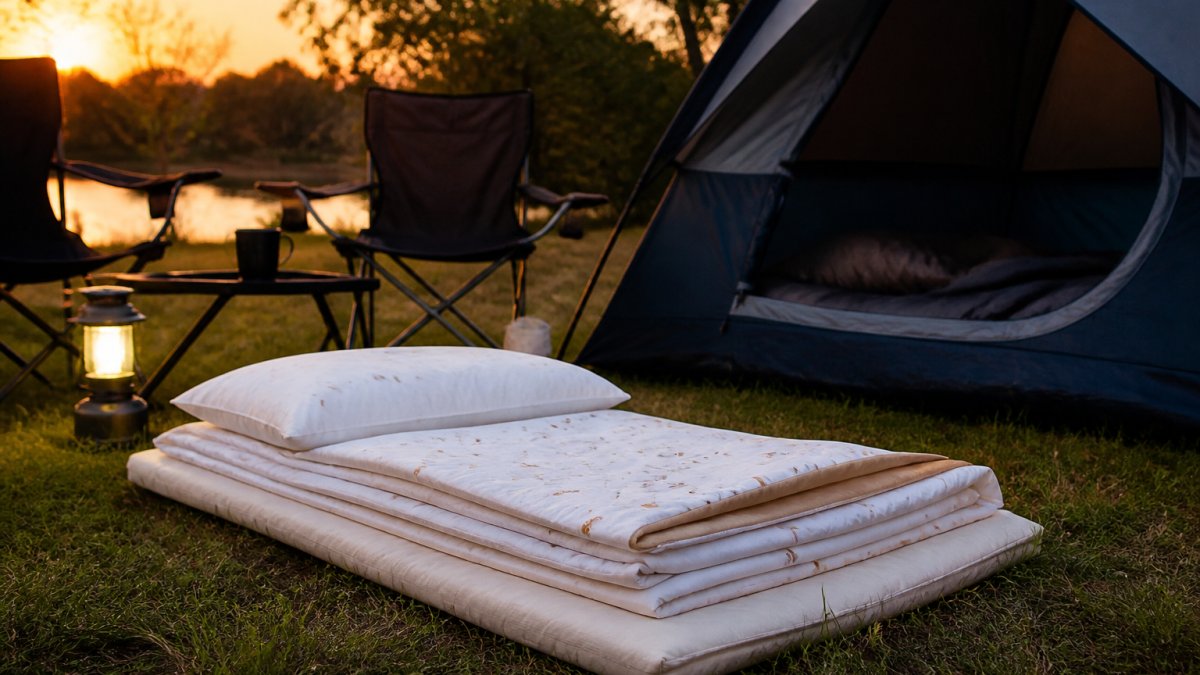
Caravan Bedding for Children: Sizing Bunks and Saving Space
Caravan bedding for children comes down to two measurements: the bunk's internal width and the clearance above it. Get those two numbers before you buy anything, because caravan bunks are narrower and shallower than a standard single bed, and a standard doona will bunch against the wall all night.
Measure the mattress, not the frame. Then measure from the mattress top to the underside of the bunk above. If there is less than about half a metre of clearance, a thick mattress topper will make the bunk feel like a coffin and your child will refuse to sleep in it.
Space saving comes from flat packing. Bedding that folds into a compact bundle stores under the dinette seat or in the front tunnel boot. Bulky doonas and rigid mattress bases eat storage you do not have.
Watch out: caravan bunk mattresses are often thinner than bedroom mattresses, so a fitted sheet sized for a home single will wrinkle and pull loose. Look for bedding with an elasticated or envelope fit rather than relying on tucking.
Portable Bedding for Toddlers: Weight, Packing and Settling In
Portable bedding for toddlers has to do two jobs at once: pack small enough for a saloon boot, and feel familiar enough that a two-year-old actually lies down on it. Weight matters because you are carrying it plus a child plus everything else.
A practical target is bedding your toddler can help carry. If the bundle needs two hands and a hip, it is too heavy for the role. Rolled or flat-packed designs beat anything that needs a pump, a frame or assembly at 8pm in the dark.
Settling in is the part most guides skip. Toddlers settle on familiarity, not novelty. Bring the same bedding you use at home, keep the bedtime routine identical, and set the sleep space up before your child is tired rather than during the meltdown. A consistent surface, same smell, same texture, does more for settling than any gadget.
For parents who want a deeper comparison of options, our guide to the best portable sleep solution for toddlers covers what to prioritise when packing light.
Sustainable Kids Swags: What Ethical Production Should Look Like
Sustainable kids swags should be judged on materials, traceability and repairability, not on a green label. Three questions separate genuine ethical production from marketing: what is the fabric made from, where was it made, and can you get a straight answer about both?
Recycled fibres are a reasonable starting point, but recycled content alone says little about working conditions or longevity. A swag that lasts eight years and gets repaired once is more sustainable than three cheap ones that fail.
Ask suppliers directly. A brand committed to ethical production will tell you the fibre source, the mill or factory, and how the product is finished. Vague answers about "eco-friendly materials" are a signal to keep looking.
Durability is part of the ethics conversation too. Reinforced seams, a waterproof backing and fabric that tolerates frequent washing all extend life. Parents who want the wider picture can read our guide to buying eco-friendly children's travel products, which sets out what to check before you commit.
Common Mistakes Families Make When Buying Travel Bedding
The most common buying mistakes are predictable, and each one costs money. Here are the ones we see most often, with the fix for each:
| Mistake | What goes wrong | The fix |
|---|---|---|
| Buying before measuring | Bunk or cot sheets do not fit | Measure mattress width and clearance first |
| Choosing synthetic fills | Clammy nights, lingering odour | Choose breathable natural fibres |
| Skipping the waterproof layer | Damp mattress, ruined trip | Check for a waterproof backing |
| Buying one "all seasons" set | Too hot in summer, too cold in winter | Build a base layer and add insulation |
| Ignoring wash instructions | Fabric pills or shrinks after a few cycles | Confirm it is machine washable |
| Packing bulky bedding | No boot space left | Choose flat-packed or rollable designs |
The pattern behind all six is buying for the showroom rather than the trip. Before you spend anything, our portable kids bed buying guide walks through the checks in order.
Choosing Your Travel Bedding from Cozie Dozie Co.
Choosing well comes down to four checks: measure your space, match fabric to climate, confirm it washes, and make sure it packs small. Do those and you avoid most of the mistakes above.
This is where we come in. Cozie Dozie Co. makes portable, sensory-safe sleep and play environments for children, designed on Country and crafted from butter-soft recycled French linen with a waterproof PUL canvas backing. The range is flat-packed for convenience, built for rest and adventure alike, and ships free Australia-wide, including to families in Mount Larcom and across regional QLD. If you have been searching for travel bedding near me and want something that holds up to real family use, we would love to help.
Frequently Asked Questions
What bedding should you take camping with children in Australia?
Start with a base layer that copes with warm days and cool nights: a breathable linen or cotton quilt cover, a waterproof-backed mat, and a familiar pillow from home. Australian camping swings from 35°C afternoons to single-digit nights, so layering beats one heavy doona. Add a spare set in a separate bag so a wet or sandy night does not end the trip. Keep each child's bedding in their own labelled bag to make packing and unpacking faster at every stop.
How do you choose caravan bedding for children when bunk sizes vary?
Measure the bunk mattress before you buy anything, including the lip of the frame. Caravan bunks are often narrower and shorter than standard single beds, so a regular fitted sheet will bunch. Look for bedding with elasticated corners or a flat-backed mat that tucks under the mattress. Lightweight layers work better than thick doonas in a confined bunk, and a waterproof backing protects the mattress from spills and overnight accidents on long trips.
Can familiar bedding help children settle in a new place?
Consistency is the main reason portable bedding works. Children who sleep on the same sheet, with the same texture and smell, have fewer surprises when the room around them changes. For children with sensory processing differences, the feel of the fabric against skin matters as much as the routine. Packing the same bedding for camping, daycare and visiting family gives them one constant across every environment, which supports settling rather than disrupting it.
How do you wash and dry travel bedding while on the road?
Choose fabrics that tolerate a cold machine wash and dry quickly, ideally linen or cotton rather than heavy synthetics. On the road, a laundry stop every few days is usually enough if you carry one spare set per child. Rinse sandy items at a tap before bagging them, and air bedding over a camp chair or annex line rather than leaving it damp in a bag. Waterproof-backed items should be hung backing-up so water drains away from the fabric.
Your next trip does not need to involve wrestling a doona back into a stuff sack at midnight. Get started with Cozie Dozie Co. and give your kids a familiar, comfortable place to rest wherever the road ends.
