

Last Updated: November 22, 2026
Quick Summary
To improve your child sleep routine away from home, keep the order of your wind-down steps rather than the exact clock time, and pack the same sleep cues such as the familiar blanket, toy and story book. Set up a safe, dark sleep space and expect the first two nights to be the hardest.
- Pack sleep items in one labelled bag and keep it in the car within reach.
- A bedtime can shift by an hour on holiday without much damage.
- Bring bedtime forward by 30 to 45 minutes after a missed nap.
- Shift bedtime by 15 to 20 minutes a day when crossing time zones.
- Test any new sleep product at home before the first night away.
Table of Contents
- Why Child Sleep Routine Gets Disrupted Away from Home
- Helping a Toddler Sleep in a New Place: Preparation Before You Leave
- What to Pack for a Child Sleeping Away from Home
- Maintaining a Bedtime Routine on Holiday Without Rigidity
- Baby or Toddler Sleep in a Holiday Bed: Setting Up a Safe Space
- Managing Travel Days, Naps and Overnight Waking
- Troubleshooting Persistent Sleep Disruption and Sensory Needs
- Choosing Portable Bedding That Supports the Routine
- Frequently Asked Questions
Why Child Sleep Routine Gets Disrupted Away from Home
A child sleep routine rarely survives the first night in a new place without a plan.
Families across regional Queensland often describe this same challenge. The disruption is rarely about the child being difficult.
Children rely on predictable cues to feel safe enough to fall asleep.
Travel adds three more pressures: late arrivals, long days in the car, and shared rooms where everyone hears everyone.
Aim for familiar rhythms rather than trying to recreate home exactly.
If your child's sleep environment itself keeps causing trouble, it helps to understand what makes the best kids sleep environment for travel before you pack.
Helping a Toddler Sleep in a New Place: Preparation Before You Leave
Preparation starts days before you zip the suitcase. Helping a toddler sleep in a new place works best when the new place is not a total surprise.
Try these steps:
- Talk about the trip in simple words. "We'll sleep at a different house. Your blanket comes too."
- Set up the travel bed at home for one nap, so it is not brand new on arrival.
- Keep the last night at home as normal as possible. No late-night packing chaos in their room.
- Pack the sleep bag first, not last.
- Show photos of the accommodation if you have them.
A common mistake is hyping the trip so much that bedtime feels like a letdown. Keep the excitement for daytime.
For babies, the same logic applies with less explanation and more repetition. Familiar smell and familiar sleepwear do most of the work.
What to Pack for a Child Sleeping Away from Home
Knowing what to pack for a child sleeping away from home removes half the stress.
Your sleep kit should include:
- The usual comfort item or favourite toy
- Familiar bedding, including the top sheet or blanket they use nightly
- A portable bed or floor lounger
If you are still deciding on the bed itself, our guide to the best portable sleep solution for toddlers walks through the options.
Pack the sleep items in one labelled bag so you are not digging through suitcases at 8pm. Keep it in the car within reach.
Maintaining a Bedtime Routine on Holiday Without Rigidity
Maintaining a bedtime routine on holiday is about keeping the order, not the clock. The sequence matters more than the exact time.
Keep these three anchors:
- The wind-down order: bath, pyjamas, story, lights down.
- The sleep cues: same blanket, same toy, same song.
- The dark room: block light as best you can.
Drop the rest. Bedtime can shift by an hour on holiday without much damage. What hurts is skipping the wind-down entirely because everyone is exhausted.
We suggest a "portable routine" written on your phone: four steps, in order, no negotiation. When grandparents or a partner handles bedtime, they follow the same list.
For families staying with relatives, this matters even more. Different adults mean different rules unless the list is visible.
Baby or Toddler Sleep in a Holiday Bed: Setting Up a Safe Space
Baby or toddler sleep in a holiday bed needs a safety check before anything else. Do the check while it is still light and you are not rushed.
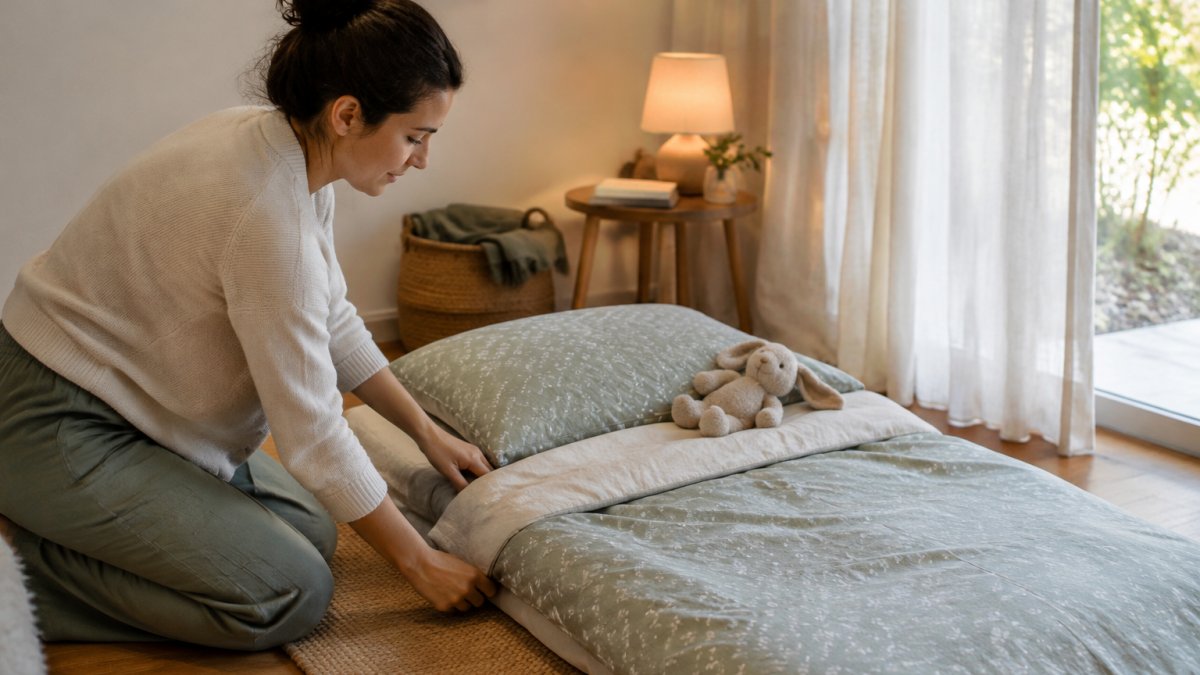
Work through this list:
- Check the bed is firm and flat, with no gaps at the edges
- Keep the sleep space clear of pillows and loose bedding for babies under one
- Move cords, lamps and furniture away from the bed
For babies, follow safe sleep guidance from your maternal health nurse or the Raising Children Network safe sleep advice.
For toddlers, a floor-level bed works well because it removes the fall risk and feels less enclosed in an unfamiliar room.
Managing Travel Days, Naps and Overnight Waking
Most routine advice stops at "protect the nap". The harder question is what to do when the day runs late, the nap happens in a moving car, or you arrive after dark. Here is a realistic plan for the situations families in Central Queensland actually meet on the road.
Before you leave
- Work backwards from bedtime when planning departure. If your child sleeps at 7pm and the drive is four hours, leaving at 2pm means arrival at 6pm with no wind-down. Leaving at 10am gives you a nap stop, an afternoon run-around and a calm final hour.
- Plan one proper nap stop, not three rushed ones. A 40-minute stop where your child actually lies flat beats two 15-minute stretches in a car seat.
- Pack the sleep kit in the cabin, not the boot. The comfort item, the sleep bag and the story book should be within reach at every stop.
Car naps: use them, don't rely on them
A car nap is a bridge, not a substitute. If your child falls asleep 20 minutes before you arrive, either wake them gently so the afternoon nap still happens, or let the car nap run and accept an earlier bedtime. Do not let a 15-minute car nap replace the main nap and then push bedtime later to compensate, that is how the first night away unravels.
Late arrivals
If you arrive after your child's usual bedtime, skip the full wind-down and go straight to the three anchors: dim light, sleepwear, comfort item. Do not attempt a bath, a full story or a room tour at 9pm. Set up the sleep space first, keep your voice low and boring, and aim to get everyone horizontal without a second wind.
Missed naps
A missed nap is not a crisis if you bring bedtime forward by 30 to 45 minutes and keep the wind-down calm. What makes it worse is a stimulating late afternoon, a pool, a playground, a big family dinner, followed by an over-tired child who cannot settle. If the nap is gone, protect the hour before bed instead.
The first night away
Expect the first night to be the hardest and plan for it. Keep the room as dark as home, use the same sleep cues in the same order, and resist lying down with your child if that is not what you do at home. Overnight waking in a new place is normal for the first two nights. Respond calmly and quietly, keep the room dark, and return your child to bed with minimal chat.
Time zones
If you are crossing time zones, shift bedtime by 15 to 20 minutes a day over several days rather than all at once. Light is the strongest cue, so get your child outside in morning daylight at the destination and dim the room in the hour before bed.
Watch out: don't schedule a big afternoon activity on arrival day. The excitement is what tips an already-tired child from settled to wired.
Troubleshooting Persistent Sleep Disruption and Sensory Needs
Persistent sleep disruption after three or four nights usually points to something specific, not bad luck. The useful question is not "what is wrong with my child" but "what changed, and is it something I can fix or something I need to adapt to". Work through the causes in order.
Step 1: rule out the physical causes
Check these first, because they are the easiest to fix:
- Light: is the room darker than home, or much brighter? A holiday rental with thin curtains and a streetlight outside is a common culprit.
- Sound: unfamiliar noises, or silence where they are used to white noise?
- Texture: different sheets, tags, or sleepwear that feels wrong.
Step 2: decide whether to adapt or hold the boundary
This is the decision most guides skip. Ask two questions: is the disruption caused by something I can change, and is the change worth the cost?
- Adapt when the cause is environmental and fixable, block the light, add the white noise, swap the sheets for the ones you brought.
- Hold the boundary when the cause is a new habit forming, a child who has learned that calling out brings a parent into the room, or that bedtime means a screen. Hold the routine, keep responses boring, and expect two to three nights of pushback.
- Seek advice when the disruption is paired with illness, pain, breathing concerns, or a change in daytime behaviour that worries you. Your maternal health nurse or GP is the right first call.
Step 3: sensory and accessibility needs
For sensory-sensitive children, texture and smell often matter more than anything else. If your child is autistic or has additional support needs, these travel sleep tips for autistic children go deeper on sensory triggers and calming strategies.
Practical adjustments that help:
- Bring the exact bedding your child uses at home, washed in the same detergent.
- Cut tags out before you leave, not on arrival.
- Keep the wind-down order identical even if the room is different.
It is also worth asking whether special travel bedding is worth it for sensory kids. For some families, the answer is a clear yes.
Step 4: safe sleep for babies versus settling for older children
The advice diverges by age, and it is worth being clear about which applies to you.
For babies under one, safe sleep comes first.
For toddlers and older children, the priority shifts to settling and boundaries. A floor-level bed works well because it removes the fall risk and feels less enclosed in an unfamiliar room.
Watch out: don't introduce a brand-new sleep product on the first night away.
Choosing Portable Bedding That Supports the Routine
The right portable bedding does two jobs: it recreates the feel of home, and it survives real family life.
Our portable kids bed buying guide covers the full checklist, but here is the short version:
| What to check | Why it matters |
|---|---|
| Fabric feel | Soft, breathable fabric helps sensory-sensitive children settle |
| Waterproof backing | Handles spills, damp grass and campsite floors |
| Packability | Flat-packed designs fit in the car without a trailer |
| Washability | Detachable covers make cleaning simple |
| Age suitability | Match the design to your child's stage |
| Portability | Carry handles make setup and pack-down quick |
At Cozie Dozie Co., our Joey loungers are built around exactly this. The Colour of Country Joey uses a butter-soft recycled French linen top sheet over a waterproof PUL-lined canvas backing, and it ships flat-packed ready to fill with pillows you already own. For families who want it ready to go, the filled Joey with four recycled pillows comes complete with a detachable blanket and carry handle.


These are designed on Country and ship free Australia-wide.
Getting a child to sleep well away from home comes down to familiar cues, a safe space and a routine that bends without breaking.
Cozie Dozie Co. offers portable, sensory-safe bedding made from recycled French linen, with a waterproof PUL canvas backing, a flat-packed design for easy packing, and free shipping Australia-wide.
Frequently Asked Questions
How long does it take a child to adjust to sleeping somewhere new?
Most children settle into a new sleep space within two to three nights when familiar cues are present. Keeping the same wind-down order, bedding and comfort item shortens that window. Some children need a full week if the environment is very different, such as a tent or a busy holiday house. Plan the first night for an early arrival and a calm, low-key evening rather than a late dinner, so the child sleep routine has room to re-establish itself.
Should I keep my child's usual nap schedule on holiday?
Yes, where you can. Daytime naps protect overnight sleep, so shifting them too far usually backfires. If an outing clashes, aim for a nap within 30 to 45 minutes of the usual time and let the child sleep in a pram, carrier or portable bed. On travel days, allow one short catch-up nap rather than dropping naps entirely. A flexible schedule that still honours the nap keeps the child sleep routine recognisable and reduces night waking.
What should I pack to help my child sleep away from home?
Pack the familiar items first: the usual bedding or sleeping bag, a comfort item, a favourite toy, a bedtime story and any white noise device. Add a portable bed or floor lounger and a night light if the child uses one. Bring spare sheets for accidents. A flat-packed option like a Cozie Dozie Joey, which folds with a built-in carry handle, keeps the sleep space consistent without filling the car.
What can I do if my child wakes more often in unfamiliar surroundings?
Respond calmly and keep the resettling routine identical to home: low light, quiet voice, minimal chat, and the same comfort item. Check for practical triggers first, such as temperature, unfamiliar noises, a wet nappy or a room that is too light. If waking continues past three nights, add one familiar cue, such as the bedtime story or white noise, at every resettle. Persistent disruption with distress is worth raising with your child health nurse.
